
TANIOBIS Awards Two 2026 Doctoral Prizes
Two dissertations impressed the review committee for this year’s TANIOBIS Doctoral Award in Solid-State Chemistry and Materials Research: Dr. Vasiliki Faka and Dr. Pascal Kolodzeiski were honored in September 2026 at the GDCh Conference on Inorganic Chemistry in Jena. Both dissertations make contributions to materials relevant to energy storage and functional materials of the future.
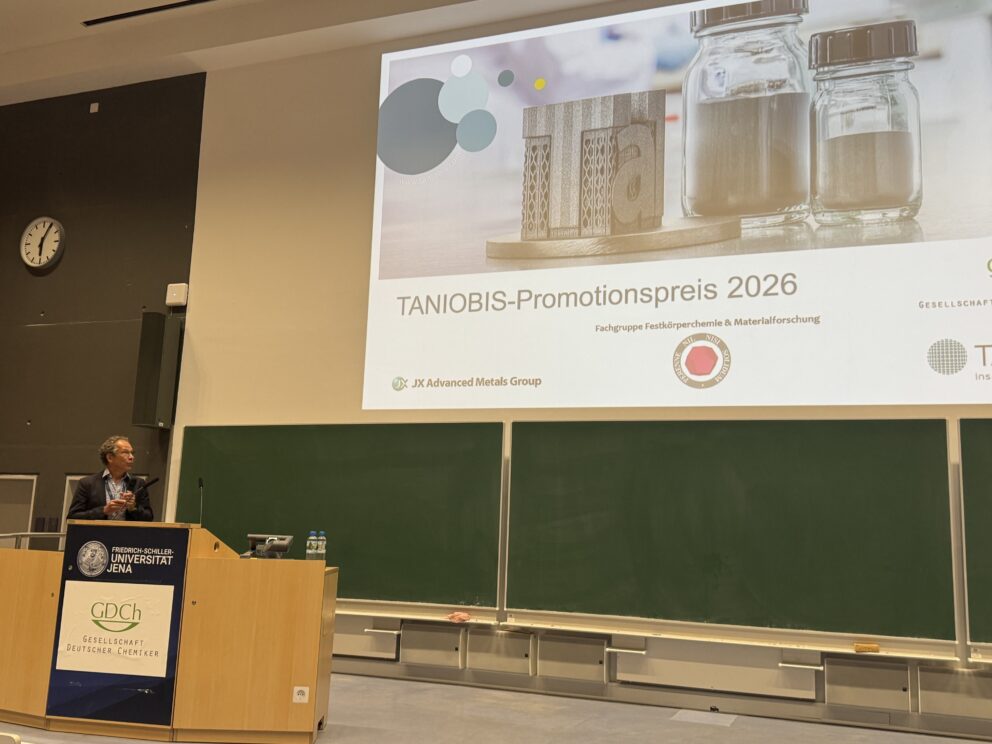
Dr. Markus Weinmann at the presentation of the 2026 TANIOBIS Doctoral Award at Friedrich Schiller University in Jena.
The award, which is presented every two years, is intended for early-career researchers whose dissertations in the field of solid-state chemistry and materials research demonstrate outstanding scientific quality. The submitted dissertations were all of a high scientific standard. “Two of these theses stood out in particular due to their methodological precision and their relevance to materials research,” explains Dr. Markus Weinmann, who works in research and development at TANIOBIS and served on the review committee. “That led us to split the award this year.” The award was presented by Prof. Angela Möller, Chair of the Solid-State Chemistry & Materials Research Division of the German Chemical Society (GDCh), and Dr. Markus Weinmann.
Pressure as a Solution for Solid-State Batteries
Solid-state batteries are considered one of the most promising technologies for energy storage in the future. At their core lies the solid-state electrolyte. Dr. Vasiliki Faka, who completed her dissertation at the University of Münster, demonstrated in her thesis “Influence of Pressure on Structure and Transport Properties of Sulfide-Based Lithium and Sodium Ion Conductors” that mechanical pressure can specifically improve the structure and conductivity of solid-state electrolytes. Pressure creates permanent dislocation lines in the material, which facilitate ion transport and increase conductivity. Combined with chemical pressure resulting from element substitution, this opens up a common scientific framework for targeted structural modification. This is a significant step toward the development of safer solid-state batteries capable of fast charging.
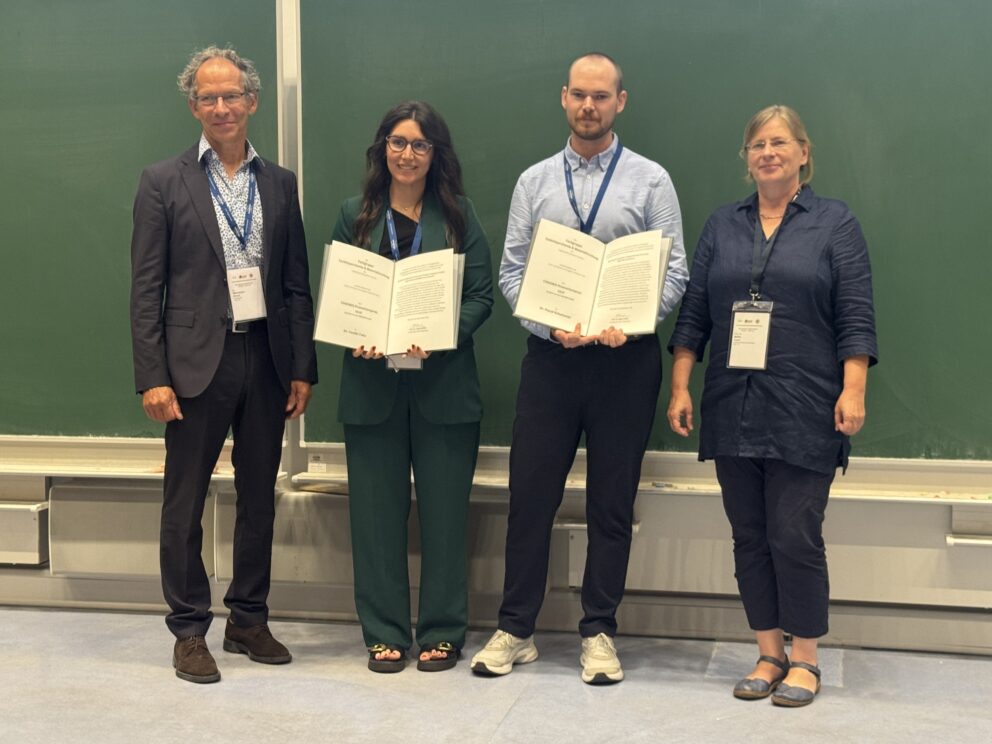
Ceremony for the presentation of the 2026 TANIOBIS Doctoral Award in Jena (from left to right): Dr. Markus Weinmann, Dr. Vasiliki Faka, Dr. Pascal Kolodzeiski, and Prof. Angela Möller.
New Control Principles for Organometallic Glasses
Metal-organic frameworks, or MOFs for short, are porous hybrid materials with a wide range of potential applications, from gas storage to catalysis. Dr. Pascal Kolodzeiski, who completed his dissertation at the Technical University of Dortmund, identified two new approaches in his thesis, “Metal-Organic Frameworks: Concepts from Glass Science and High-Pressure Behaviors,” to specifically control the structures of these materials. In the first part, he demonstrated that organic lithium and sodium salts can be used as network modifiers in MOF glasses, thereby systematically influencing structure, thermal behavior, and porosity. In the second part, he investigated how metal identity, linker length, and diamine functionalization determine the behavior of MOFs under hydrostatic pressure. The results provide a deeper understanding of porous and glass-like hybrid materials and open up new approaches for their targeted further development.
“Both award recipients demonstrate how basic research and applied research can converge,” summarizes Dr. Markus Weinmann. “It is precisely this combination of scientific depth and practical relevance that we aim to promote with the doctoral award.”
TANIOBIS sincerely congratulates Dr. Faka and Dr. Kolodzeiski and wishes them every success in their future work.